

What Is Skip Tracing?The Complete Guide
Skip tracing sounds mysterious, like a black box that spits out phone numbers. It isn’t. This guide covers what it actually is, how to do it by hand, who uses it, whether it’s legal, and when it’s worth automating.
What Is Skip Tracing?
Skip tracing is the process of locating current, verified contact information (a phone number, email address, or mailing address) for a person who isn’t easy to reach through normal means. The term comes from an older use: finding someone who “skipped town” on a debt, a court date, or a lease.
In real estate, skip tracing usually means finding an absentee owner, an heir, or a seller whose contact details aren’t accurate anywhere public. It’s one step past a basic contact lookup: a simple data append pulls whatever phone or email is already on file for a name and address. Skip tracing kicks in when that first pass comes back empty, wrong, or unanswered, and it takes a deeper cross-check across multiple sources to actually reach the person.
That distinction matters for pricing and expectations. A tool that only appends already-known numbers isn’t doing skip tracing in the fuller sense. It’s doing match-append. Real skip tracing waterfalls through several data sources, cross-references what it finds, and returns a verified result.

Where Skip Tracing Came From
Skip tracing existed long before real estate used the term. Bail bondsmen and debt collectors coined it for tracking down people who missed a court date or stopped paying a loan. Those people, almost by definition, didn’t want to be found. Early skip tracers worked phone books, credit bureaus, and personal networks by hand.
Real estate investors adopted the same playbook for a different problem: absentee owners, inherited properties, and sellers who’d simply moved without updating anyone. The data sources have modernized. Public records databases, address history files, and API-driven identity resolution have replaced phone books, but the core task hasn’t changed: cross-reference enough sources to land on a current, reachable contact.
How Skip Tracing Works: The Manual Process
Before automating anything, it helps to know what skip tracing actually involves by hand. If you’re tracking down a property owner yourself, here’s roughly the order most investigators work through:
- Call the phone number and email on file first. If the person answers, you’re done.
- Check the mailing address. Owners often live somewhere other than the property itself, and the mailing address on the tax roll is a common next stop.
- Look for a USPS forwarding address if mail is bouncing. It can point to a new address.
- Try a courier instead of the mail. A FedEx or UPS delivery tends to get opened and answered more often than plain mail, since it reads as more urgent.
- Pull other addresses associated with the person. Prior addresses on file often lead to a current one, or at least to a neighbor who knows where they went.
- Run a search engine check. Obituaries, news mentions, and business listings can surface current details fast.
- Check social media. Facebook, LinkedIn, and Instagram profiles sometimes list a current city or employer, and connections can lead to relatives.
- Reach out to neighbors. Someone next door often knows more than any database will.
- Contact relatives. Adult children, siblings, or parents can often pass along contact info or explain the situation.
- Try a genealogy site. Ancestry-style tools are surprisingly effective at mapping family connections when direct contact fails.
- Run a background check. This can surface an incarceration record, which explains a lot of unresponsive contacts and comes with its own outreach path.
- Hire a private investigator for the hardest cases. PIs have access to specialized databases most consumers, and most businesses, can’t reach directly.
If the property is owned by an LLC or a trust, none of the above works until you’ve identified the actual person or people behind the entity. That’s its own lookup step, not a variation on the process above.
Doing all of this by hand for one property might take twenty minutes. Doing it for two hundred properties is a different problem entirely. That’s where automation comes in, covered further down.
Who Uses Skip Tracing
Skip tracing shows up anywhere someone needs to reach a person who hasn’t made that easy:
- Real estate investors chase absentee owners, tax-delinquent properties, and inherited homes where the listed contact info is stale or missing. See our guide for Real Estate Investors.
- Agents run into the same wall on expired listings and FSBO sellers who post only a burner number. Residential Agents & Brokers covers that workflow.
- On the commercial side, the problem shifts: you’re usually looking for the people behind an LLC or trust, not an individual homeowner. See Commercial RE Agents & Brokers.
- Mortgage professionals use it differently again, mostly to reconnect with past borrowers around refinance timing. See Mortgage Professionals.
- Home service professionals reach for it less often, usually to track down a remote or absentee owner before a renovation pitch. See Home Service Professionals.
How much depth you need depends on who you are. An agent chasing one expired listing can work through the manual process above by hand; a business running this at real volume needs an automated version of the same steps.
Is Skip Tracing Legal?
Yes, when it’s done for a legitimate purpose and within the rules that govern the data being used. The main frameworks to know:
- FCRA (Fair Credit Reporting Act) governs any use of consumer report data. If the skip tracing touches credit-related information, FCRA permissible-purpose rules apply.
- TCPA (Telephone Consumer Protection Act) governs outbound calls and texts, particularly to cell phones and particularly with autodialers.
- State and federal Do Not Call (DNC) registries restrict cold-calling numbers that have opted out.
Skip tracing itself isn’t illegal. What you do with the results is what’s regulated. Real estate outreach, debt collection, and process serving are all legitimate purposes; what matters is scrubbing your list against DNC before a calling campaign and keeping your outreach honest about who you are and why you’re reaching out. Skip Sherpa’s DNC Scrub add-on checks numbers against the national registry before you dial, which is the most common compliance gap teams run into.
What “Good” Skip Tracing Looks Like: Match Rate & Data Quality
Not all skip tracing is created equal, and the gap between providers is usually invisible until you’re mid-campaign dialing dead numbers. A provider can post an impressive match rate and still hand you a list full of disconnected lines, because a “match” only means a data source returned something for that name, not that the number actually works.
What actually matters is accuracy, not volume. A shorter list of verified, current numbers beats a longer one padded with stale entries, since every wrong number burns a dial and, at scale, damages your sender reputation. A number that shows up across two or more independent sources is far more likely to be current than one pulled from a single database. Freshness matters too: contact data decays, and a number that was accurate eighteen months ago has a real chance of being dead today.
Skip Sherpa’s waterfall process cross-checks multiple sources before returning a result, specifically to keep the gap between “matched” and “actually reachable” small.
Manual Skip Tracing vs. an API: When to Do It Yourself vs. Automate
The manual process outlined earlier works fine for one property. It doesn’t scale. Working through that same twelve-step sequence for a list of five hundred owners means roughly 150+ hours of work, longer if a meaningful share need the deeper steps (relatives, genealogy sites, private investigators).
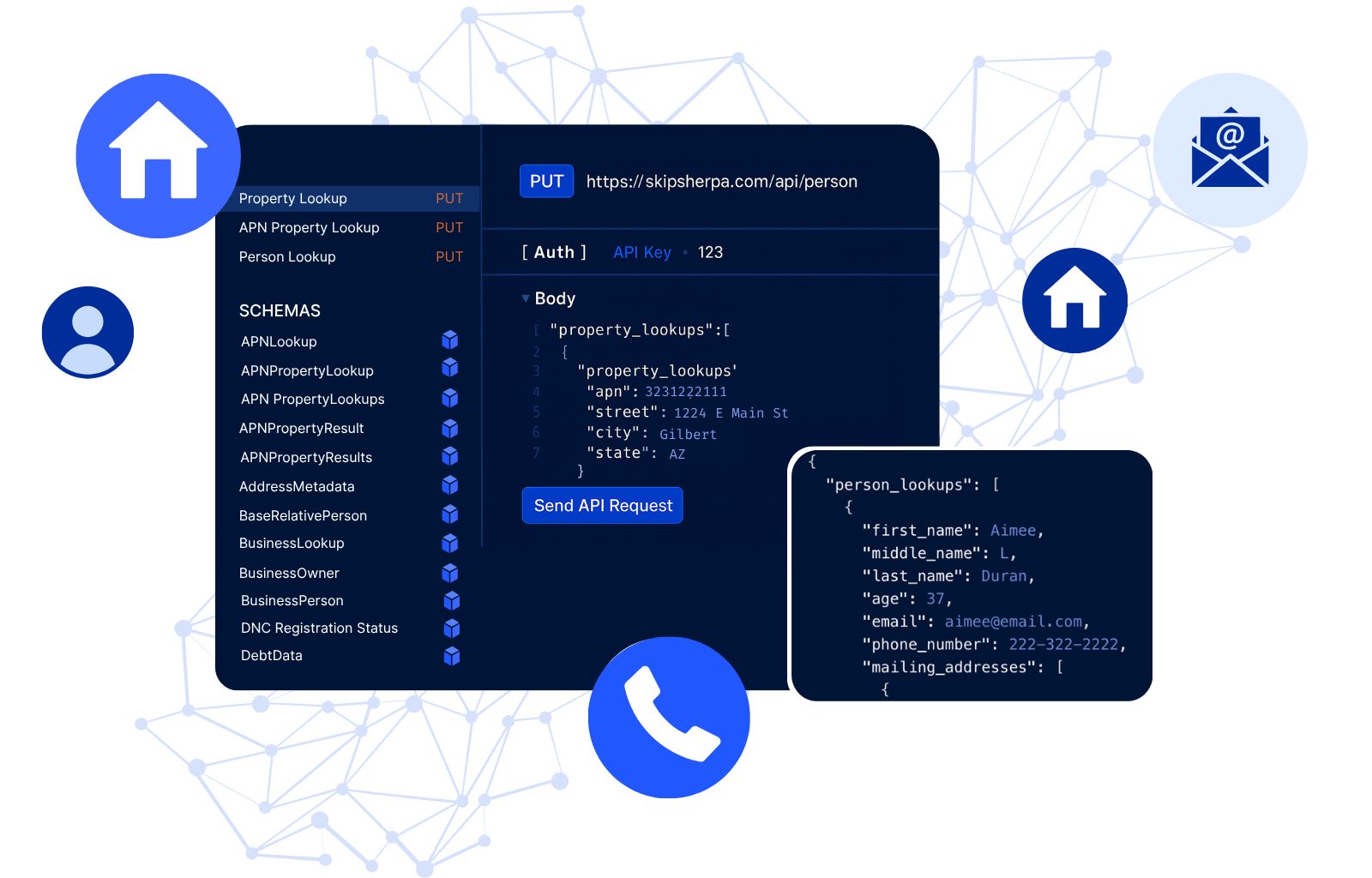
An API replaces the whole sequence with one call: submit a name or address, get back cross-checked, standardized contact and property data in a single response. The trade-off is straightforward. For one property, worth the extra effort, the manual process is fine, and free. For a list of any real size, or a repeatable workflow, an API pays for itself almost immediately in time saved, and it returns more consistent results than hand-searching ever will.
Most teams end up doing both: automated skip tracing for the bulk of a list, with the manual process reserved for the handful of properties worth extra digging, the ones a database alone won’t crack.
How Much Does Skip Tracing Cost?
Pricing varies by provider and volume, but expect to pay per successful match rather than per attempt. A fair structure only charges when data actually comes back. Skip Sherpa’s pricing starts at $30/month for 200 hits ($0.15/hit) and scales down to $0.08/hit at higher volume, with usage blocks available for larger one-off pulls. See the full pricing breakdown for current rates.
Skip Tracing Checklist
A quick-reference version of the manual process above:
- Call the phone number and email on file
- Check the mailing address
- Look for a USPS forwarding address
- Try a courier (FedEx/UPS) instead of mail
- Pull other addresses associated with the person
- Run a search engine check
- Check social media
- Reach out to neighbors
- Contact relatives
- Try a genealogy site
- Run a background check
- Consider a private investigator for high-value, hard-to-crack cases
- If the property is LLC/trust-owned, identify the people behind the entity first
FAQ
Is skip tracing legal?
Yes, for a legitimate purpose like real estate outreach, debt collection, or process serving, and as long as it stays within FCRA, TCPA, and DNC rules.
What’s the difference between skip tracing and a simple phone/email lookup?
A lookup appends whatever contact info is already on file. Skip tracing goes further, cross-referencing multiple sources to find a person when the first pass comes back empty or wrong.
How accurate is skip tracing data?
It varies by provider. Anything above roughly 70% match accuracy is considered strong in the industry; ask any provider for their real accuracy rate, not just their match rate, since the two aren’t the same thing.
Can I skip trace an LLC or trust-owned property?
Not directly. You first need to identify the person or people behind the entity, then skip trace them individually.
How is Skip Sherpa different from doing a manual skip trace?
Skip Sherpa automates the cross-referencing step: one API call returns verified owner, contact, and property data pulled from a waterfall of sources, instead of working through each step by hand.
Skip the manual process
One API call returns verified owner, contact, and property data from a waterfall of cross-checked sources: 50+ data points, transparent pricing, no daily caps.
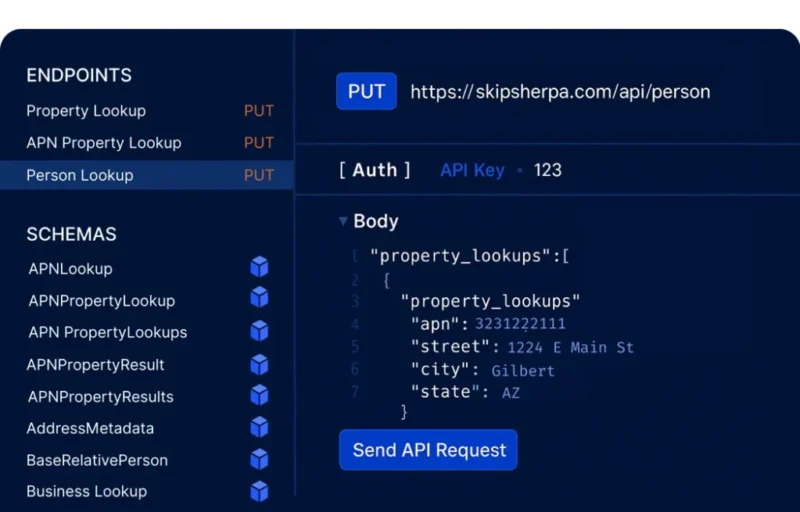
Documentation Designed To Make Developers Happy
From clean requests to detailed responses, our docs give you the confidence to integrate faster. Easy to scan, simple to test, and always accurate.
TESTIMONIALS